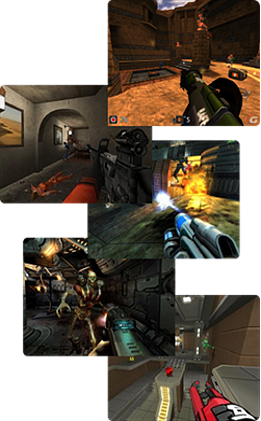
We have a few great Free Software gaming engines now, like DarkPlaces used in Nexuiz; Cube 2 used in Sauerbraten; Qfusion used in Warsow; id Tech 3 used in Call of Duty 4: Modern Warfare, Quake 4, Doom 3; soon id Tech 4 which is used in Enemy Territory: Quake Wars along with many others; and HPL1 used in Frictional Games' Penumbra trilogy series.
All of these engines have some combination of normal mapping, bump mapping, and/or parallax mapping -- where flat walls can look bent, dented, sticking out or poking in, just by using one or two textures. Cube 2 can actually render high quality textures and very large maps in a matter of seconds. Qfusion has nice cel-shaded graphics capabilities. And id Tech 4 and HPL1 actually have very nice physics capabilities.
DarkPlaces is based on the Quake 3 engine or "id Tech 3", despite that it has graphics on par with id Tech 4. id Tech 4 hasn't been "open-sourced" yet, it is planned to be released under the GNU GPL in 2011.
Three of these game engines (DarkPlaces, Cube 2, and id Tech 4) are always geared towards the same gameplay-style, you know, a gaming style similar to Duke Nukem, where you run around shooting everything in your way and occasionally a bit of story is thrown in -- a gameplay style I like, but don't love.
And this is what I want to talk about.
I like Quake and Duke Nukem, but I prefer more tactical games, like UrbanTerror, True Combat, Battlefield, Call of Duty, etc. However, most of these are proprietary games, which I don't have too much of a problem with, because I have no need to modify them for any practical use. But I can't help but be disappointed that developers aren't taking advantage of the advanced Free Software game engines, especially since most of the games mentioned above don't have versions for GNU/Linux.
All these great game engines are not used to the fullest potential, they are used mainly by the developers for the developer's own games, even though the game engines allow for a magnitude of different playing styles.
There is good news, though, there are many differences between Nexuiz and Penumbra, for example: Nexuiz is fast-paced and has many weapons while Penumbra is slow, very strategical, there are no weapons but boxes, chairs, or whatever you can find, Penumbra's gameplay is based on a player's clever usage of physics and not a player's use brute force. For this reason I think Penumbra's HPL1 engine paves a very nice path to interesting gameplay styles, different from that of Quake, Doom, and Duke Nukem. And I think it's been the case for a long time that the Quake gameplay style died out long ago.
